
Physics Rediscovered #20: Prototyping Maxwell's equations


Our story of the quest for unified electromagnetism picks up where we left off last time. Again, we follow the lead of the self-taught, self-made, universally dismissed, British chap named Michael Faraday.
We already saw how he tackled the strange and confusing phenomenon of magnetic induction with the concept of magnetic lines of force. These were the curved strands that went in and out of magnets and swirled around wires. Invisible to the naked eye, they could be revealed by sprinkling iron filings, where one suspected they could be present.
Faraday showed that the myriad of induction experiments he authored, could be explained with the condition that these lines had to be cutting a conductor, so to speak, or be cut by it. Either by relative movements or expansion, this mutual intersection was the magic that allowed him to move objects and generate electricity at a distance, without touching anything.
As the story goes, this idea was received poorly by his contemporaries. His lack of academic swagger and mathematical incompetence didn’t make it easier for others to digest what Faraday was serving.
Now if you think people didn’t entirely love this idea of magnetism, his next one would garner him nothing but contempt.
Fortunately for mankind, Faraday just couldn’t take a hint.
Electric dumpster fire
Before we get into any of it, we need to remind ourselves about what a confused and chaotic mess electricity in the 19th century was.
We made sparks fly around by rubbing things together or building ever higher or longer Voltaic piles. We could also do that by warming things up (so called thermic electricity) and by touching fish… Yes, we’ve figured out that some fish generate electricity on their own and it freaked people out, as it should.
All these could be similar or maybe even the same phenomenon, but who could really tell. To make matters worse, Faraday came along and made currents flow by waving magnets, therefore introducing a completely new form of electricity — a magnetic one.
Ok. Stop. This is getting out of hand, right? Well, Faraday thought so too. He decided that, instead of inventing any more new stuff, it was time to clean out the closet.
So where to start? Faraday decided it’s back to the basics. He didn’t like this, then popular idea of electricity being a fluid, acting at a distance on things, by means of magic, or through the mysterious, omnipresent ether, which is another way to say ‘magic‘ without using the word.
This electric fluid was Benjamin’s Franklin idea. You know, one of the Founding Fathers of a little place called the USA. We’ve learned about Franklin’s electric adventures here. The man made many experiments focused on electrically charging different things. On of those was about electrifying a silver jar (silver being a conductor) and observing that nothing interesting really happens inside it. It seemed that whatever this electric fluid was, it wanted to stay on the surface of the conductor, completely ignoring its interior.
Charles-Augustin de Coulomb, the author of the Coulomb’s law, repeated the same experiment, but with his fancy-shmancy, ultra precision (for the time) torsion balance and confirmed that no electric shenanigans happened inside conductors.
Faraday saw that and, as was his style, he decided to go big. To prove Franklin’s and Coulomb point, he built a large, cube-shaped cage made from a conductor. It was large enough for him to live in and he did. As he was calmly sipping tea inside the cage, his assistant was discharging bolts of lightning into the cage, of an intensity that would kill a small elephant. Faraday and all the compasses, and meters, and whatever he could stick inside seemed unaffected by the electrical hell outside.
Here is a guy on YT demonstrating it in practice by electrocuting Benjamin Franklin.
The cage experiment led Faraday to think that when an electrified body interacts with another one of its kind at a distance, no electrical fluid is being transferred or created, or anything of the sort. What we are actually seeing, he argued, is charge rebalancing. Whatever electrical happens outside, the charge reorganizes so that the inside stays neutral. This is what happens in a conducting cage, as well as in a conducting wire.
He called it induction.
So that’s great, but what about stuff that was considered non-conductive?
Faraday figured out that such materials were not entirely immune to induction. Take glass, for example. Specifically, take one piece of it and bring it into contact with an electrified body. What you’ll notice (and what Faraday did) is that, while completely neutral before, the side of the piece opposite of the touching surface displays some electric presence.
So why not then stick a piece of induction resistant material, a type which Faraday started calling dielectrics, between two conductors?
Let’s do that, thought the Brit and what he noticed is that the induction occurs on both conductors, but it’s weaker than without the dielectric in between.
As far as spectacular experiments go, this one probably doesn’t even make the list. However, upon seeing this, Faraday came to several really hard-hitting conclusions.
Firstly, he grew ever convinced that whatever electricity is, it cannot be this magical fluid that creates this spooky action at a distance. Instead, he proposed that there are these tendrils coming out of electric things, these lines of inductive force, which transmit this action. Positively charged things send out these lines directed outward (there would be sources) and negatively charged lines would be direction inward (sinks). In this case we would have attraction of opposites. If the lines emerged from the same type of sources they would clash, resulting in repulsion. Here’s the overall picture:
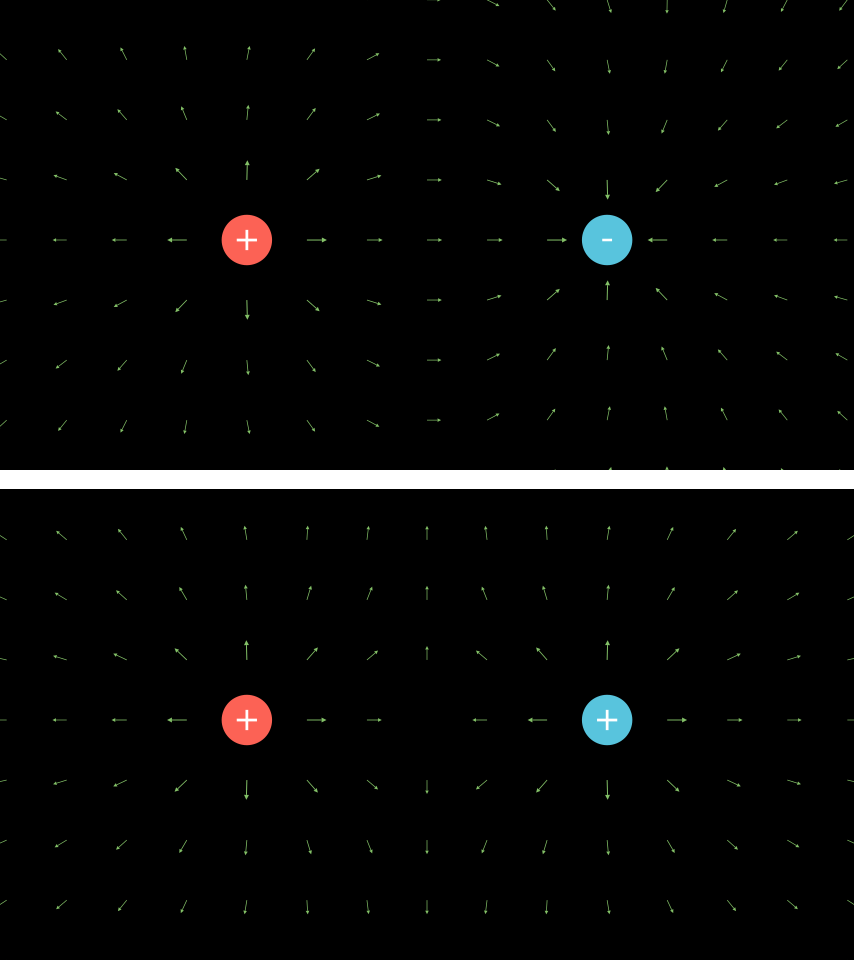
Secondly, he realized that all matter has some intrinsic resistance to this force of induction. What we call “conductors” resist this force, not letting the lines inside. On the other hand dielectrics accepted them and were able to sustain the tension that these lines created. Therefore it seemed that different materials had different specific inductive capacities.
Thirdly, it appeared to him that it is absolutely necessary for dielectrics (air being among them) to be present, in order for any electric phenomena to occur as these were the medium of transmission of the lines of inductive force, or as he would later call them electric lines of force.
The way Faraday talks about this sounds really weird to us today, but the man was trying to fix over a century of conceptual and linguistic mess so let’s give him a break. Also, keep in mind that the lines of inductive force where considered separate from his magnetic curves, which were supposed to explain all things magnetic.
Speaking of which…
Same as water but different
Michael Faraday was widely recognized for his discoveries. It’s just his ideas about those discoveries that people had trouble digesting.
The magnetic curves that were supposed to explain the effects of magnets inducing electric currents were already fairly hard to accept. At least people could see those by sprinkling iron filings around magnets and wires.
The lines of inductive force, however, were likely even worse. It was way more abstract, not supported by any mathematics, contrary to common conceptions about electricity and you just couldn’t see those as the magnetic ones. I mean, invisible tendrils coming out of electric sources, clashing and pushing against each other if from the same, signed charges, but joining and attracting if from opposite ones? That doesn’t sound very scientific, does it? A lot of people back then thought so as well.
For a moment there things seemed bleak for the physics of electricity. All this complexity with some interesting but outlandish ideas, little math around them and seemingly no way forward. However, ideas are notoriously hard to kill. I wanted to tell you, gentle reader, that it’s the good ones that are even more resilient, but any internet experience seems to provide evidence to the contrary. Fortunately, they had no internet back then.
Not having to waste time on TikTok or convincing people that the Earth is not actually flat, mathematically inclined people started to revisit Faraday’s concepts.
One of those people was William Thomson, later to become known as lord Kelvin. The same guy from the Kelvin temperature scale and countless other things. Probably most known for his work in thermodynamics, he had his hands in basically everything one could have when it came to physics.
He tried adding some mathematical rigor into Faraday’s writings but, with all due respect to the man, I’m going to ignore him. Instead, we will pay attention to his friend and student, James Clerk Maxwell, who he have already met here:
Maxwell and his merry band of physics nerds were ready and said that:
…several of us here wish to attack Electricity.
Thomson directed them to Faraday and as we know from Maxwell’s series of publications called “On Faraday’s Line Of Force“ (started in 1855) he took up the challenge so that:
…by the strict applications of the ideas and methods of Faraday, the connexion of the very different orders of phenomena which he has discovered may be clearly placed before the mathematical mind.
In order to do that he needed to:
“…obtain a geometrical model of the physical phenomena, which would tell us the direction of the force, but we should still require some method of indicating the intensity of the force at any point.”
Easier said than done.
As usual when tackling the unknown, you start with something you know and Maxwell began to think about electricity as a mechanical system. Specifically, he thought about fluid mechanics. Thus, he envisioned that these lines represent “tubes“, in which an incompressible fluid flows. He didn’t really believe such tubes were real, but the mental framework was useful, especially since the subject has been well studied since Newton’s times.
Thinking about electricity as similar to water in pipes may have seemed like a long shot, but it turned out to be a killer idea. With this approach Maxwell showed similarities between pressure, as found in pipes, and electric tension (which we call voltage today). These are the comparisons that we still use today in order to instill some intuitions in young, innocent and still hopeful physics students.
However, there was something else to come out of those analogies. Something much more important. With some mathematical gymnastics and one or two educated guesses, a realization struck Maxwell right in the middle of his bearded face. He figured out that by investigating how Faraday’s lines of electric force went in and out of enclosed spaces could tell you how much electric stuff was contained within that space.
Confusing, I know. Let’s look at some pretty pictures then.
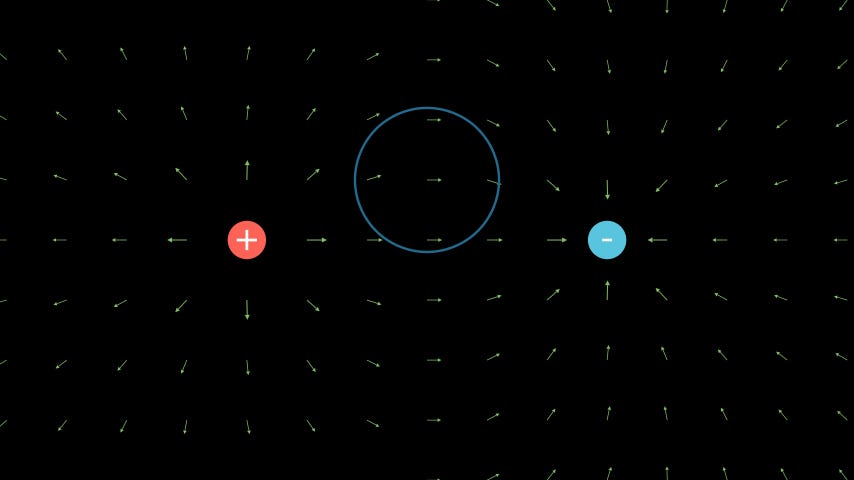
Here we have an enclosed space in form of a circle. Mind you, it doesn’t have to be a circle. I can be whatever as long as there are no holes in it. Information would escape through those holes, so to speak. If you follow the arrows from the positive charge, you could say that some amount of arrows enters the circle and the same amount leaves it on the “other side“. If this balance is maintained then we can say that there are no sources and sinks within that circle (there’s one other possibility, but just a moment). Now check this out:
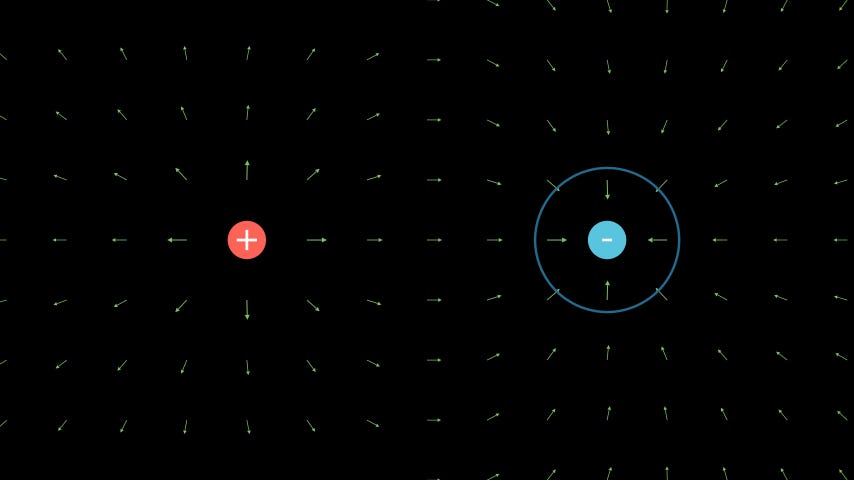
In this case a lot of arrows seem to fall into the circle, but none leave. That means the balance is not maintained. Furthermore that balance seems to be shifted toward arrows falling in. That means there must be a sink inside the circle. And look! What a coincidence! But wait, there’s one more.
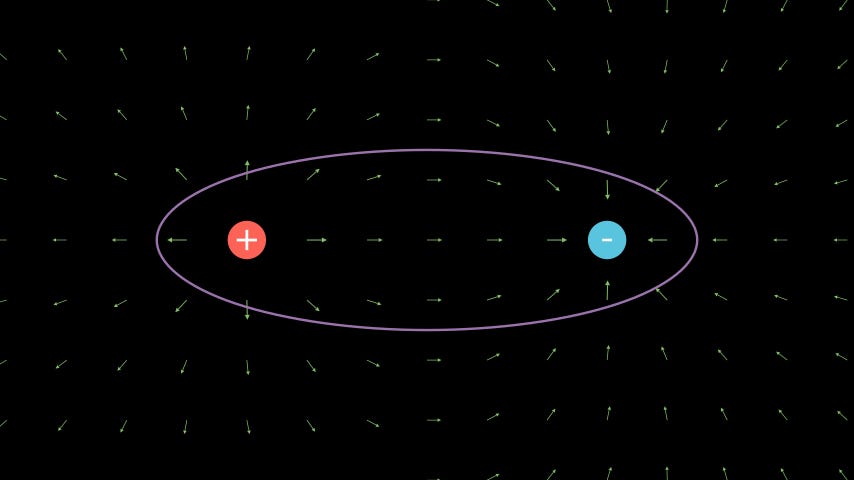
This time we have an ellipse, because it just looks better (remember, it could be anything). Now, if we trace the arrows punching into the ellipse and punching out, we will find that they match. This is a similar case to the first one. There we said that this type of balance means that there are no sources and sinks within the enclosing surface. But, obviously, it can also mean that the number of sources and sinks inside the surface is the same and of the same power.
But what if they were of different power? Well, if one of the sources was, say twice as strong the as the sink than the arrows on the picture (or lines of force) would be twice as dense, meaning we would count twice as much outgoing arrows as incoming.
Almost there
This simple picture tends to break down at some point, but helps with the intuition. However, where pictures are insufficient, math always prevails and Maxwell demonstrated just that. He represented the intuition behind the electric lines of force as follows:
Don’t fret, here is what it means. We have a 3D space represented by directions x, y and z. The electric lines of force have their components in all three directions: a in x, b in y and c in z. By taking the derivatives like da/dx we are asking how much a given component of the lines of force changes in a given direction. Using the pictures above, it’s like asking which way the arrows are pointing. Doing that in all three dimensions tells us what is the density of electric sources and sinks within an enclosing surface. That density is represented by ρ (rho). There could be none of it, so ρ = 0 or there could be equal amount of both sources and sinks, so again ρ = 0 (because we add them up with opposite signs). Finally, ρ could be something other than 0.
Holy shit! This is awesome, almost certainly thought Maxwell.
Then he figured that this concept of lines passing through arbitrary curves and surfaces can be applied to magnetism as well as electricity.
Let’s recall that magnetic lines seem to curve around a wire, for example, and their intensity depends on the amount of current inside the wire. So maybe, we can tell how much current there is if we trace how these magnetic lines follow some arbitrary curves. Check this out:
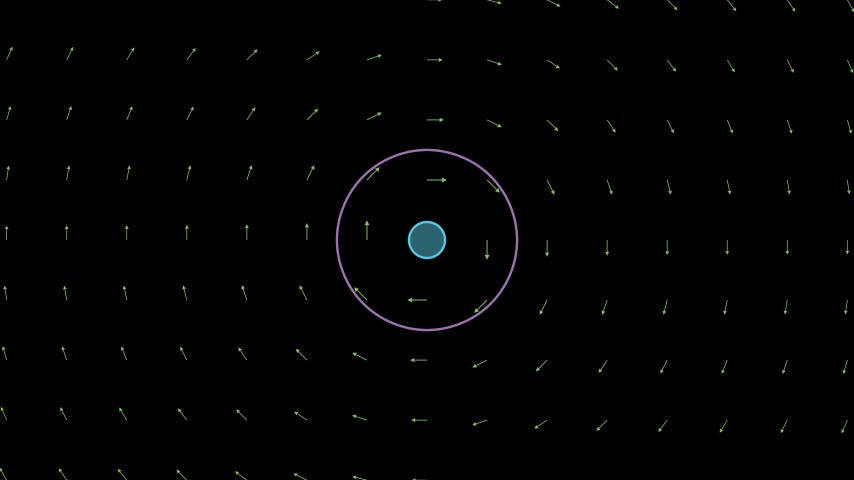
The blue circle in the center represent a wire, with the current flowing right in our faces. The arrows represent the lines of magnetic fields and the purple circle is our arbitrary curve. Remember, it doesn’t have to be a circle. It can be anything as long as it is closed, otherwise we have spillage.
Following Maxwell, I’ll show what this means in mathematical terms so that it doesn’t hurt too much:
I know, but bear with me. Again we have three dimensions x, y and z. Now x is the direction of the current, so straight into our eyes. This means that the picture above represent the remaining dimensions: y and z. The small a asks what is the amount of electrical current going in the x direction. β (beta) tells us about the magnetic arrows in the y direction and γ (gamma) in z.
Notice how different it is from the previous equation. There where checked how the electric arrows change in their respective directions. Here we check how each component of the magnetic lines changes in different directions, except their own. This is the mathematical representation of rotation of the lines, or as they called it back then — curl.
Now, I get things are getting somewhat abstract here. You might be looking at this and saying “Omg, so what!“ and maybe all of this doesn’t sound to you, gentle reader, as if this was a groundbreaking epiphany or an achievement of any kind.
First of all:

Second, finally someone managed to put some of Faraday’s ideas into mathematical form, which is a yuuuuge deal. Faraday saw Maxwell’s work and was beyond impressed. He wrote:
MY DEAR SIR I received your paper, and thank you very much for it. I do not say I venture to thank you for what you have said about “ Lines of Force,” because I know you have done it for the interests of philosophical truth ; but you must suppose it is work grateful to me, and gives me much encouragement to think on. I was at first almost frightened when I saw such mathematical force made to bear upon the subject, and then wondered to see that the subject stood it so well.
Damn, people knew how to write letters back then.
But perhaps more than anything else, this will turn out to be one the most spectacular triumphs of theoretical physics. Just you wait.
This story will continue in the next episodes of Physics Rediscovered.
Stay tuned!
"β (beta) tells us about the magnetic arrows in the y direction and γ (gamma)."
Gamma does what?